Top Stories
The Athletic: How Pistons can unlock Cade Cunningham’s off-ball looks for more offense
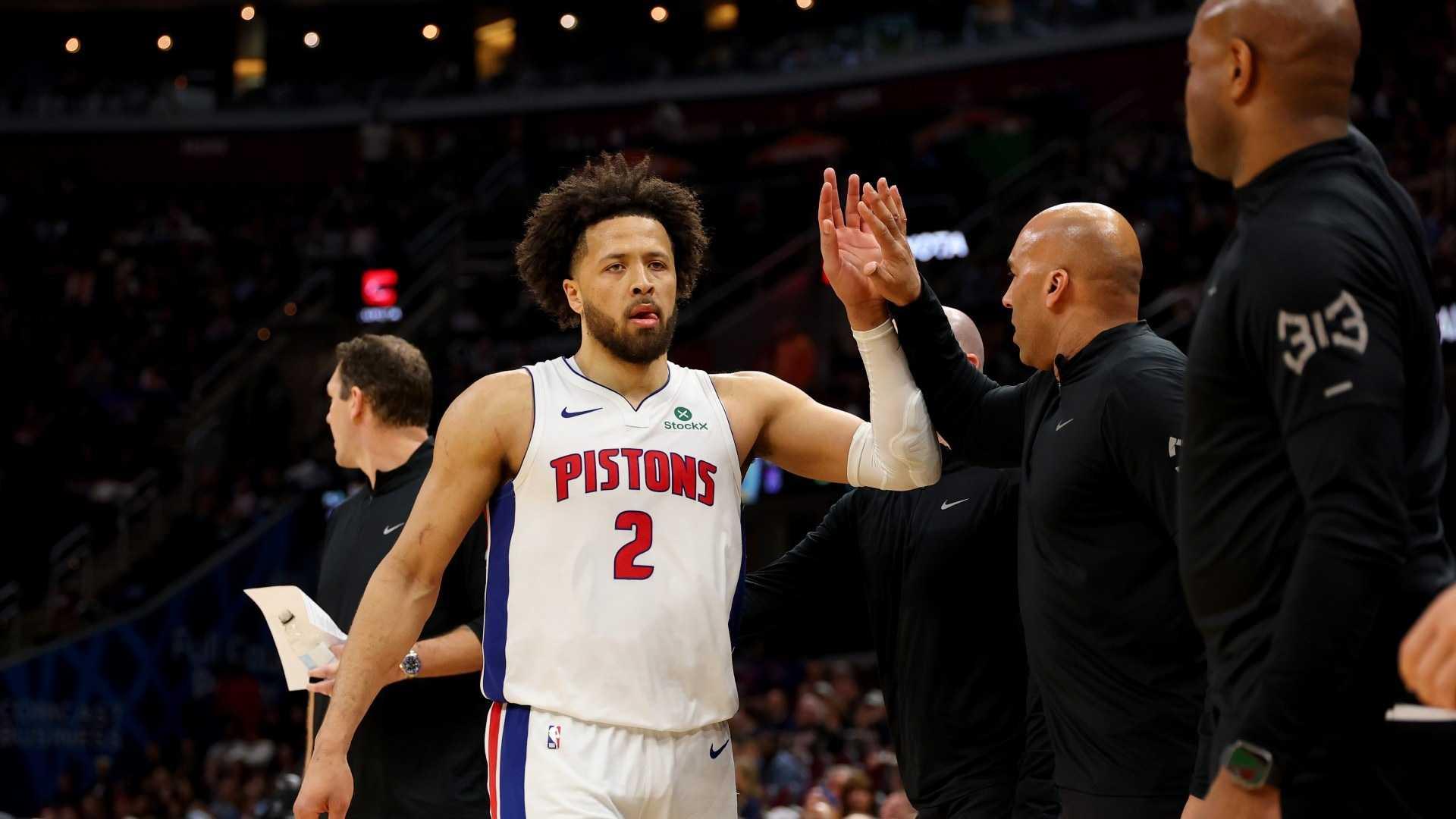
Cunningham can continue to grow this season, and his work off the ball could help him take another step.
Hunter Patterson, The Athletic
September 2, 2026 5:46 PM
The Detroit Pistons and head coach J.B. Bickerstaff have some options if they want to improve the offense next season.
Editor’s Note: Read more NBA coverage from The Athletic here. The views on this page do not necessarily reflect the views of the NBA or its teams.
Inside the University of Miami practice gym last month, adjustments were brewing that could turn the Detroit Pistons into title contenders. Cade Cunningham and Ausar Thompson, two of the Pistons’ pillars, fine-tuned the chemistry they’ve built over their three seasons together. New veteran Taurean Prince accompanied them in pickup games against Memphis Grizzlies rookie Cam Boozer, Thompson’s twin brother Amen, Miami Heat guard Davion Mitchell, and others. Cunningham and Thompson took turns attacking defenders and sharpening their offensive skills. They will each play a vital role in any success Detroit is looking to build on this coming season—just in different ways.
Beginning with Cunningham, more off-ball looks would benefit his offensive attack individually and the Pistons as a whole. As valuable as Cunningham is with the ball in his hands, one facet of his game has, out of necessity, gone largely unexplored: his ability to score as an off-ball threat.
Cunningham shot 48.8 percent from 3-point range on 41 catch-and-shoot attempts during the postseason, while shooting 75 percent from distance on one dribble and 50 percent on two dribbles. The one- and two-dribble sample size is much smaller, with Cunningham only attempting eight and 10, respectively. But his most recent playoff performance—with the added physicality the postseason presents—could be a reason to explore more consistent actions for Cunningham to score without being the point of attack. He’s shown a willingness to let others initiate offense, whether it be Thompson or Daniss Jenkins.
Isaiah Joe (42.3 percent), John Collins (40.6 percent), Prince (43.6 percent), and even Gary Harris (41.2 percent)—all new offseason acquisitions—shot at least 40 percent from beyond the arc last season. Detroit’s roster this season could be the best 3-point shooting roster assembled around Cunningham. Though it is a tall task to rival the shooting of the 2024-25 team, it’s not out of the realm of possibility for the Pistons—especially if coach J.B. Bickerstaff can get creative enough with his schemes to marry enough on- and off-ball looks for Cunningham to be aggressive.
Cunningham is one of the most gifted players in the association when ball-dominant, and they shouldn’t take too many of those opportunities off the table for him. But the upside of occasionally freeing Cunningham to come off pindowns rather than relying so heavily on a pick-and-roll-heavy offense could have a trickle-down effect. Not only could Cunningham conserve energy for the game’s waning moments, but he could use his gravity to generate open looks for the aforementioned shooters and put someone like Thompson into a more prominent role as a ballhandler.
“Teams decide they want to pick Cade up full court, and sometimes because of the gravity he holds, people just hug up on him,” Bickerstaff said in October last year. “You can play advantage situations off of him, but now (if he isn’t initiating offense) his defender has to play off a screen or off a shift. It just makes (Cunningham) a better player when people can’t get their hands on him, wrestle and hold him.”
Thompson showed signs of being an effective wing initiator in spurts last season. His career-best 15.5 assist percentage ranked in the 73rd percentile for wings. The 23-year-old harnesses the physical tools to make it happen, from his 7-foot wingspan to the speed and fast-twitch muscles that should make him difficult to stay in front of.
“We want to put the ball in (Thompson’s) hands more,” Bickerstaff said. “And then getting Cade off the ball just brings another dynamic to our offense. As we continue to grow the foundation of our offense and our systems on both sides of the ball, we’ll always look to add different things that can make us better.”
Cunningham’s younger counterpart could prove as crucial as anyone in the locker room in aiding his development as an off-ball scorer. The off-ball actions Cunningham thrived in most in the playoffs were plain spot-up shots and shots coming without a dribble from handoffs. He was good for 1.41 points per possession in those situations, which ranked in the 96.6th percentile of all players and was the highest of any player to play in at least 10 games last postseason. Cunningham then produced 1.30 points per possession as a spot-up shooter, ranking in the 84th percentile. Compare those statistics to Cunningham’s 0.87 points per possession as the ballhandler in pick-and-rolls and 0.76 points per possession in isolation, and it’s fair to want an uptick in off-ball plays for him.
“It’s good to mix it up. It’s good to be on the ball, off the ball to give different looks,” Cunningham said in October when asked about Thompson having more ball-handling responsibilities. “I think it’s good for the group, as far as me and (Thompson), to allow us to really put our energy out there on the line. So picking our spots and going back and forth is good for both of us. And (Thompson) is a guy that can initiate offense at a high level, so just giving him room to get more and more comfortable with it.”
A right-ankle sprain 10 games into the regular season seemingly derailed Thompson from blossoming into the facilitator Cunningham and Bickerstaff had envisioned. Thompson averaged 13.9 points and 3.4 assists per game during his first 10 outings and was far more featured offensively than he was throughout the remainder of the season. Bickerstaff and Detroit president of basketball operations Trajan Langdon both publicly expressed at end-of-season news conferences their desire for Thompson to take a leap offensively. And Thompson has already spent several hours training with Cunningham this summer.
If the next evolution of Cunningham’s game includes more off-ball looks—coupled with a high volume of ball dominance—and if Thompson can continue making strides as an offensive initiator, that could provide the kind of internal growth that molds the Pistons into a legitimate title contender.
Hunter Patterson is a staff writer for The Athletic covering the Detroit Pistons. Before joining the NBA staff, Hunter was an editor on The Athletic’s news desk and provided occasional Sacramento Kings coverage. Prior to The Athletic, he worked for the NBA as a broadcasting assistant. Hunter graduated from Loyola Marymount University and earned his master’s degree in Specialized Journalism at the University of Southern California. You can follow Hunter on X @HunterPatterson.
Related
‘26-27 schedule brings plenty of intrigue
From the 76ers’ early test to back-end drama, check out the top 7 takeaways from the schedule for the upcoming season.
10 must-see clashes during first 2 months
Breaking down the most intriguing storylines and matchups to watch in October, November, and December this season.
Offseason Power Rankings: State of East
Get a team-by-team look at where all 15 squads in the Eastern Conference rank after the 2026 offseason.
Cunningham's singular focus driving Pistons' rise
Cade Cunningham is savoring the team's success these days after stomaching a 28-game losing streak early in his career.