Top Stories
The Athletic: Inside the Sixers’ Busy Summer — How Philly Landed LeBron James and Jaylen Brown
To get LeBron, Mike Gansey needed to first land Jaylen Brown. Here’s how Philadelphia’s mega-summer came together.
Tony Jones, The Athletic
September 8, 2026 · 8:33 PM
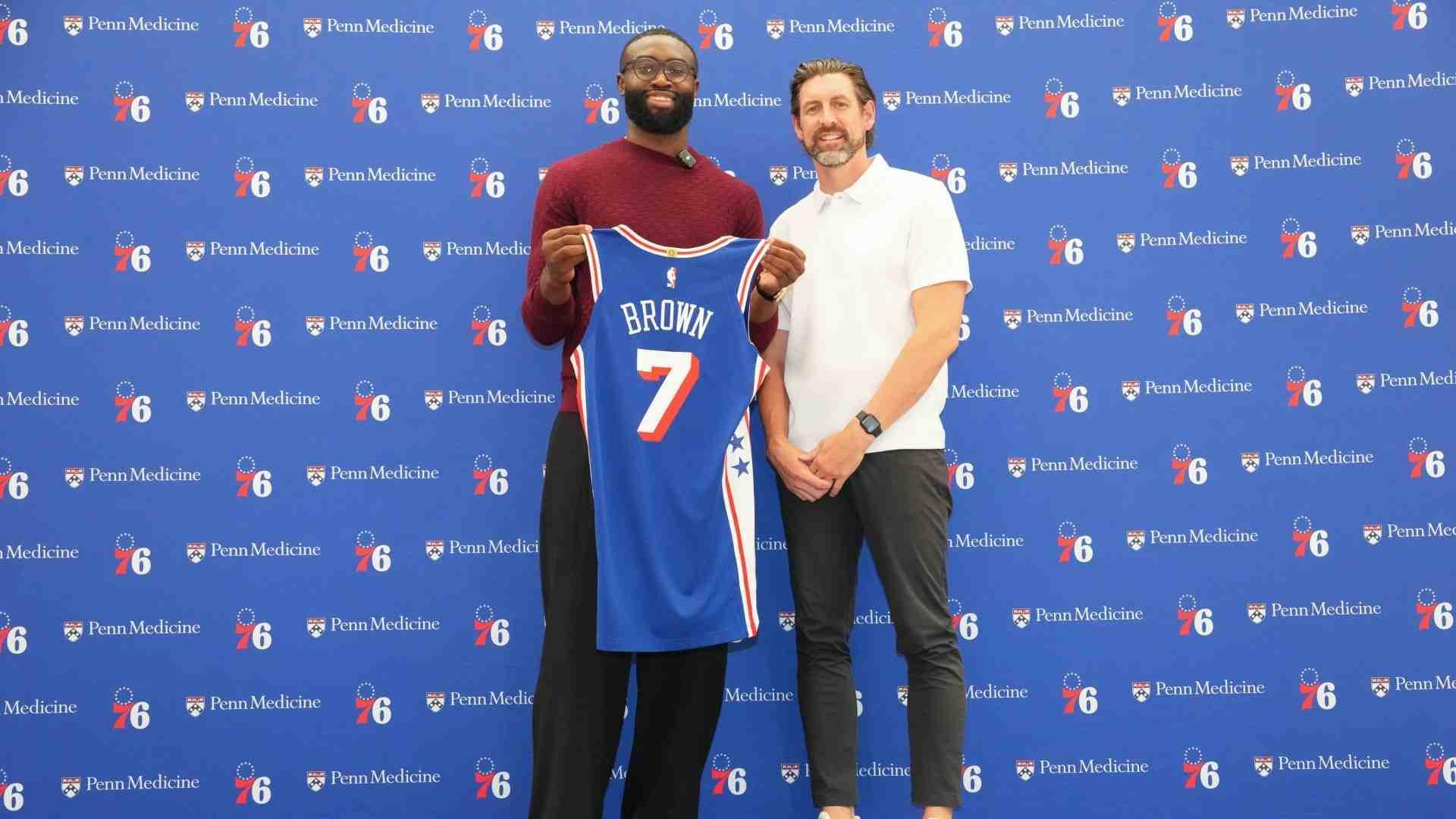
Landing Jaylen Brown unlocked a magical summer for new Sixers president Mike Gansey.
Editor’s Note: Read more NBA coverage from The Athletic here. The views on this page do not necessarily reflect the views of the NBA or its teams.
PHILADELPHIA — The kids, wide-eyed, waited their turn to speak to Mike Gansey. In the sweltering Francis J. Myers Recreation Center, one by one, well-wishers, Philadelphia 76ers personnel and family members approached the man who has been the team’s president of basketball operations for fewer than four months.
Those months have been spectacular, which is why everyone was gathered this hot August afternoon for Jaylen Brown’s introductory news conference. But it was the children, gathered en masse, who put the day — and the entire summer — into context.
As Gansey greeted them, shaking hands, taking photos and smiling endlessly, one stepped forward with a question that encapsulated everything.
“Are you the one who got us LeBron?”
Yes, Gansey is the guy who got them LeBron. But first, he had to get Jaylen Brown.
For as much credit as the Sixers deserve in landing James, it was the trade for Brown that set in motion an offseason for the ages.
When Gansey’s new group began plotting the offseason, their financial limitations seemed clear. The contracts of Paul George and Joel Embiid consumed much of their flexibility. They had the No. 22 pick in the NBA Draft and the mid-level exception at their disposal. Beyond that, the rest of their money amounted largely to smaller exceptions and veteran minimums.
So Gansey and general manager Jameer Nelson settled on a simple philosophy: They would call everyone.
During Gansey’s days as GM in Cleveland, resilience and persistence had been drilled into him. Cavaliers owner Dan Gilbert would routinely call, text or email some version of the same question: Did we call and check on this guy? Did we call everyone?
“There were some trades that we’ve done that were two years in the making, simply because we kept calling,” Gansey told The Athletic in an extensive sit-down interview. “We kept checking in, and in the end we came away with that person. It didn’t always work, but we always wanted to make sure we did the work.”
That philosophy ultimately led them to Brown.
The Sixers knew they weren’t the first — or even the second or third team — on Boston’s radar, but they kept calling. They also knew the Celtics’ preferred path involved trading Brown to pursue Giannis Antetokounmpo. Philadelphia kept calling anyway.
When Boston lost the race for Antetokounmpo to the Miami Heat, the dynamics changed for Philadelphia, according to league sources. Brown’s name had surfaced publicly in those trade talks, and there was a point of no return. The Celtics almost had to trade him.
Even then, Philadelphia viewed itself as a long shot, according to league sources. Conventional wisdom suggested Boston would rather trade him to a Western Conference team than trade an All-NBA-caliber player to a division rival. But as Brown’s market softened, Gansey and the Sixers were still there. When the opportunity became real, Philadelphia decided it wasn’t going to lose Brown over the Clippers’ 2028 first-round pick.
“The process in talking to Boston about Jaylen took a couple of weeks,” Gansey said. “We let them know we were interested and then just kind of went from there. We just kind of stayed in the mix, and the next thing you know, we were at the five-yard line … We just kept banging the drum and expressing interest.”
Getting Brown proved to be the move that unlocked Philadelphia’s ability to recruit James. But how the Sixers approached this summer provides a window into the new man in charge of the front office.
In addition to conversations with Gansey and head coach Nick Nurse, The Athletic spoke with three league sources with direct knowledge of Philadelphia’s offseason maneuvering. The sources spoke on the conditions of anonymity because they were not authorized to publicly discuss private trade talks, negotiations and recruitment efforts.
And in the end, they were able to land the ultimate prize. Now they have to go out and play the games.
“To be honest, it all still feels kind of surreal,” Gansey said. “I’m sure it will hit more, once the season begins and we see the team in uniform.”
Here’s how Philadelphia’s mega-summer came together.
Brown and James Transformed the Sixers — but Neither Move Was Where Philadelphia’s Offseason Began
It was reasonable to think the Sixers would largely run back the roster that finished 45-37 and fell well short in the second round against the New York Knicks.
That wasn’t necessarily a terrible outcome. Embiid, after nearly two seasons of dealing with major injuries, had proved he was still one of the best offensive players in the world. George, despite missing significant time because of a 25-game suspension for violating NBA drug policy, had a good season on both ends. Maxey blossomed into a true star. Edgecombe established himself as one of the league’s best rookies.
Internal progression from Edgecombe seemed to be Philadelphia’s best way forward. And the hope was that Maxey would have another gear he could reach, too.
Gansey knew he wanted more.
His road to Philadelphia has been more than a decade in the making. He was once an all-state high school basketball player in Ohio. In 2001, as a high school senior, Gansey was runner-up to James for Mr. Basketball. A photo of him with his arm on James’ shoulder went viral on social media this offseason when it was shared by his brother, Steven Gansey. He played at St. Bonaventure and later in the Big East at West Virginia.
Once he landed with Philly this summer, he wanted Nelson beside him. Nelson, the former Saint Joseph’s star from Chester, Pa., had risen quickly in Philadelphia’s front office. Many around the league expect Nelson to one day run a team himself.
Gansey knew improving the Sixers would be difficult, but he was drawn to the thought of building a roster around Maxey and Edgecombe. He looked at them as one of the more dynamic young backcourts in the league. He couldn’t have foreseen the success of this summer. But he believed he could build a title-level team around the two guards.
“One thing working with (Cavs president) Koby (Altman) always taught me is to be aggressive,” Gansey said. “We always have to be trying to make a team better. Always make the call and do the job.”
Gansey and Nelson promised themselves they would remain aggressive, no matter how many times they heard no.
“A lot of credit has to go to Jameer and the entire group,” Gansey said. “We knew we were obviously top-heavy with contracts. We knew that trading would be difficult because of our salaries. But, we had to do something. We knew that we wanted to do something, even if it would be difficult.
“So, we told ourselves, let’s just figure out the draft. After that, we knew that we needed to go and get some depth.”
Their first order of business focused on maximizing the draft pick former president of basketball operations Daryl Morey had left them after trading Jared McCain to the Oklahoma City Thunder. They were confident they would be able to take a good player at No. 22. That selection became Alabama point guard Labaron Philon Jr.
To fill out the roster, the Sixers decided to split the mid-level exception among two players rather than spend it all on one player. That they were able to use it on Dean Wade and Anfernee Simons says something about their vision and the realities of the current CBA. In previous eras, a team fitting two starting-level players into one mid-level slot would have been unlikely.
The Sixers knew Simons’ market was suppressed. According to league sources, part of their pitch centered on giving him a role that could help him rebuild his financial value.
Gansey played an important role in securing Wade, whom he knew from his time as general manager of the Cavaliers. He loved Wade’s potential fit with the Sixers. They needed a wing defender, and Wade is one of the league’s better wing defenders. But they also valued Wade as an offensive connector. And with several bigger possibilities still simmering behind the scenes, Gansey and Nelson knew that they would need someone who wasn’t dependent on usage.
“Dean doesn’t need the ball to be effective, and every offense can use a guy like that,” Nurse said at summer league. “He does a lot of dirty work. He defends and he’s someone who can make a lot of reads off the primary playmakers.”
Wade and his group chose the Sixers, according to league sources, in large part because Gansey and Nelson sold him on the vision of how he wanted the Sixers to work as an organization and how he wanted to build the roster. Wade and Gansey have long shared trust and a close relationship. Wade was one of Gansey’s first real finds as an executive, and behind the scenes pushed for his ever-expanding role with the Cavaliers.
By the time Wade was making his decision, league sources said, there was an inkling that the Sixers’ pursuit of Brown had become serious enough that those involved believed there was a legitimate chance a deal could happen. Wade chose the Sixers over several other suitors in part because of what the roster might become.
At that point, not even the Sixers knew just how far that transformation might go.
Over the coming days and weeks, Maxey, Embiid and Brown all took turns recruiting James, according to league sources. The Sixers believed they had more than talent to appeal to one of the greatest players ever to play the game: They also had fit.
Philadelphia ended last season with Maxey and Edgecombe as its only ball handlers capable of putting pressure on defenses off the dribble. Even at 41, James remains one of the best at manipulating a defense with his dribble. More importantly, James’ ability to pass the ball may make his fit in Philadelphia even more natural. The Sixers lacked a truly dynamic passer last season, and James gives them one.
Ultimately, James’ decision came down to having that chance to compete for what would be a fifth title of his illustrious career. And Philadelphia could offer him another intriguing piece: legacy.
The last basketball megastar to win a title in a Sixers uniform is Julius Erving more than four decades ago. Allen Iverson couldn’t do it. Embiid hasn’t done it. That alone gave James an opportunity to join one of the NBA’s most historic franchises and accomplish something no superstar had managed since Dr. J.
And before James has even played a game in a Sixers uniform, his impact on Philly has been significant.
The Sixers’ national television slate is tied with the Los Angeles Lakers for most in the league. Murals of James are popping up across the city. The Sixers will face the New York Knicks on ring night, and then visit the Lakers on Christmas Day. Philadelphia also hired Phil Handy, who has a long relationship with James, as an assistant coach.
Philadelphia is suddenly the hot ticket.
“We knew that adding LeBron to our team would make our team better,” Gansey said. “I mean, who wouldn’t want LeBron on their team? I’ve known him forever. I respect the heck out of him. We have a very good relationship.”
The 76ers haven’t won an NBA title since 1983, when Moses Malone was in his prime and Erving was two years removed from winning an NBA MVP. They haven’t been to an NBA Finals since 2001, when Iverson turned in his magical MVP season.
Those two seasons serve as bookends to decades of disappointment: years of fan apathy, a Process that couldn’t quite climb the ultimate