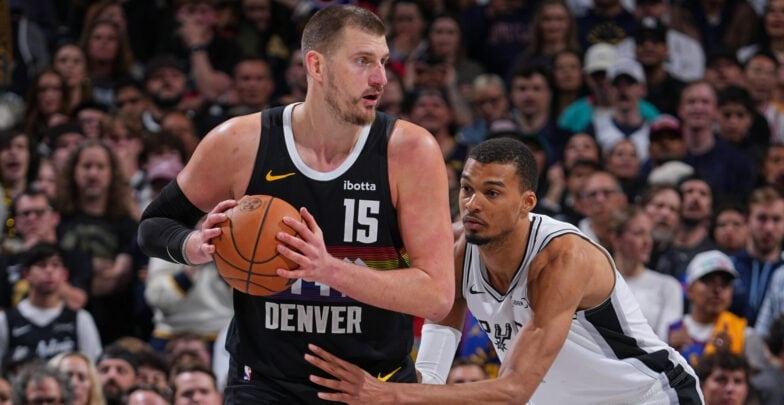
Fantasy NBA: Top 150 for 2026-27 Category Leagues
Nikola Jokić, Victor Wembanyama and Shai Gilgeous-Alexander headline the top 150 players for category leagues.
Alex Barutha, Kirien Sprecher, Nick Whalen – RotoWire.com
September 18, 2026 7:40 PM
Nikola Jokić and Victor Wembanyama continue to battle for No. 1 overall player in all fantasy formats.
Play Yahoo Fantasy High Score Today!
With the start of the preseason just two weeks away, NBA basketball is rapidly approaching. Along with it comes fantasy basketball. Below are RotoWire’s top 150 players for category leagues, with short analysis for each.
Round 1
Nikola Jokić, Denver Nuggets — There is no hole in the profile. Elite field-goal percentage on enormous volume, a free-throw line he actually helps you in, 3s at a workable clip, and top-of-the-league rebounds and assists with real steal totals attached.
Victor Wembanyama, San Antonio Spurs — The blocks are the single most valuable individual category asset in fantasy, and he pairs them with the rare combination of 3s and rebounds.
Shai Gilgeous-Alexander, Oklahoma City Thunder — Better here than in points leagues by a wide margin. Elite field-goal percentage for a guard, elite free-throw percentage on massive attempt volume, and a steal rate that plays.
Luka Dončić, Los Angeles Lakers — With LeBron James in Philadelphia, the usage goes up and so does everything that comes with it. The counting stats and 3-point volume are first-round quality; the field-goal percentage drag and the league-leading turnover totals are what separate him from the three names above.
Cade Cunningham, Detroit Pistons — Massive assist volume and good rebounding for a guard, plus 3s. The turnovers are punishing in this format, and the field-goal percentage has never been a strength. But he’s still young enough for things to improve.
Jayson Tatum, Boston Celtics — A year removed from the Achilles tear and back as Boston’s clear No. 1 with Brown gone. Tatum is one of the most well-rounded options you can get in the first round, opening up different types of team builds.
Anthony Edwards, Minnesota Timberwolves — One of the league’s best combinations of 3-point volume and free-throw accuracy from a high-usage scorer, with steals on top. Swapping Naz Reid and Julius Randle for LaMelo Ball should mean cleaner looks but a lower assist rate for Edwards.
Giannis Antetokounmpo, Miami Heat — The classic category-league puzzle. Elite field-goal percentage, elite blocks, elite steals, elite rebounds, and a free-throw percentage plus 3-point total that force you to punt or pair carefully. Build the roster around the punt and he’s better than this rank would suggest.
Jalen Johnson, Atlanta Hawks — Steals and blocks from a forward who also puts up 20/10/6 on good efficiency. The free-throw line is the weak spot and the turnovers are up with the playmaking load. Games played have also been a question mark.
Tyrese Maxey, Philadelphia 76ers — 3s at volume, a strong free-throw percentage and a sneaky-useful steal rate. The concern is that Jaylen Brown and LeBron James arriving trims the usage, and possibly minutes. Efficiency should improve with the easier looks, which partly offsets it.
Cooper Flagg, Dallas Mavericks — Produced an excellent rookie season, setting up a potential sophomore breakout into stardom. Steals and blocks from a forward, improving efficiency, and Kyrie Irving’s return should raise the quality of his shots without eating many of them.
Tyrese Haliburton, Indiana Pacers — An elite assist-to-turnover ratio, which is worth a lot in category leagues, plus 3-point volume and an excellent free-throw percentage. The offense is built for him, but coming off an Achilles injury creates downside risk.
Round 2
Scottie Barnes, Toronto Raptors — Steals and blocks from a forward with rebounds and assists is perfect for category leagues. The free-throw percentage and the low 3-point volume are the drags, and swapping Brandon Ingram for Kawhi Leonard trims the usage further.
Donovan Mitchell, Cleveland Cavaliers — 3-point volume, a reliable free-throw percentage and better steal totals than he gets credit for. James Harden handles the playmaking, so the assists stay modest. Durable and predictable.
Karl-Anthony Towns, New York Knicks — Elite free-throw shooting from a center, good field-goal percentage, 3-point volume and 12 rebounds. His lack of blocks from the center position is something managers may need to rectify later in a draft.
Kevin Durant, Houston Rockets — Still one of the cleanest efficiency lines in basketball, both from the field and the line, with 3s and about a block a game. He turns 38 at the end of the month, so rest days are the risk, but the per-game category profile gives him first-round upside.
Stephen Curry, Golden State Warriors — Much better here than in points formats. League-leading 3-point volume, a free-throw percentage near the top of the league and a real steal rate. Age and games played are a concern.
Jamal Murray, Denver Nuggets — 3s, strong free-throw shooting and a career-best field-goal percentage next to Jokić. Assists at volume with manageable turnovers. One of the safest roles in the NBA.
Alperen Sengun, Houston Rockets — Field-goal percentage, rebounds, assists and steals from the center spot, coming off career-high playmaking. The turnovers are heavy and he gives you nothing from 3, which is what keeps him behind Towns here.
Amen Thompson, Houston Rockets — Steals and blocks in combination from a wing is close to unique, and the field-goal percentage is strong. You are punting 3s and free-throw percentage to roster him, so plan the build around it.
Trae Young, Washington Wizards — Assists, 3s and free-throw percentage at elite levels with a useful steal rate. The field-goal percentage and the turnovers have to be leaned into or worked around.
Austin Reaves, Los Angeles Lakers — Elite free-throw shooting on high-attempt volume, 3s and secondary playmaking with James gone. The turnovers climb with the usage, but four of the nine categories are clear positives.
LaMelo Ball, Minnesota Timberwolves — 3-point volume near the top of the league plus steals and assists. The field-goal percentage and turnovers are negatives, and now there’s a question of how much the offense runs through Edwards instead. Games played is still a question.
Chet Holmgren, Oklahoma City Thunder — A category-league player. Blocks and 3s from a center, with a solid field-goal percentage and a free-throw line he helps you in. The raw counting totals are ordinary, which matters much less here compared to points formats.
Round 3
Josh Giddey, Chicago Bulls — Rebounds, assists and steals from a guard, with his 3-point shooting finally landing. The turnovers are the tax on a nightly triple-double threat running the offense.
James Harden, Cleveland Cavaliers — 3s at volume, free-throw attempts at a good rate, assists and steals. The field-goal percentage and turnovers are both negatives, so he’s a build-around rather than a plug-in.
Devin Booker, Phoenix Suns — A down shooting year means he’s discounted. He’s still Phoenix’s primary creator with strong free-throw shooting, decent 3-point volume and assists. Positive regression on the field-goal percentage is the upside case.
Anthony Davis, Washington Wizards — Twenty games last year. When he plays, it’s a first-round category line: field-goal percentage, double-digit boards, blocks and steals together. Pair him with durable pieces and take the swing.
Kawhi Leonard, Toronto Raptors — Is still capable of MVP-level two-way numbers. A clean bill of health last season cuts against a decade of evidence, and Toronto’s depth gives him easy reasons to pull back on minutes and usage.
Trey Murphy III, New Orleans Pelicans — A major category riser. High-volume 3-point shooting at a good clip, strong free-throw percentage and low turnovers. Dejounte Murray’s return trims the usage, but the shooting profile is exactly what this format pays for.
Evan Mobley, Cleveland Cavaliers — Blocks, steals and rebounds with an ordinarily strong field-goal percentage. Last year’s shooting slump is the reason he’s here rather than a round earlier, and a bounce-back is reasonable.
Jalen Brunson, New York Knicks — Excellent from the field and the line for a high-usage guard, with 3s and assists at volume. Zero blocks and modest steals mean you need defensive stats elsewhere.
Domantas Sabonis, Sacramento Kings — Field-goal percentage, huge rebounding and center-position assists. No blocks and heavy turnovers are the two holes. With Russell Westbrook retired and DeMar DeRozan in Denver, the usage should climb back toward his peak.
Derrick White, Boston Celtics — One of the format’s signature assets. 3s and blocks and steals in the same line, plus a strong free-throw percentage and low turnovers. Fewer shots with Tatum back and Paul George added, but the category shape is unaffected.
Lauri Markkanen, Utah Jazz — 3-point volume, a very good free-throw percentage and rebounds from a forward. Utah’s win-now additions should improve his availability while costing him shots. Low steals, blocks and assists caps his upside.
Bam Adebayo, Miami Heat — A well-rounded line from the center position. The addition of Giannis Antetokounmpo could mean fewer boards but more 3-pointers.
Round 4
Jalen Williams, Oklahoma City Thunder — Balanced and efficient two-way statline. Wrist surgery and a hamstring problem wrecked last season, but he’s still OKC’s No. 2 option.
Walker Kessler, Los Angeles Lakers — Has been providing strong traditional big-man stats, and that’s not expected to change now that he’s in Los Angeles rather than Utah. Easy lobs from Luka Dončić give him strong field-goal percentage potential.
Deni Avdija, Portland Trail Blazers — An All-Star breakout with 3s, rebounds and playmaking from a forward. The field-goal percentage and turnovers are the drags, and the Ja Morant and Damian Lillard additions threaten his touches.
Kyrie Irving, Dallas Mavericks — A strong category-league riser. Elite field-goal and free-throw percentages, 3-point volume, steals and one of the lowest turnover rates among high-usage guards. Coming off an ACL tear at 34, which is creating a discount.
Jaren Jackson Jr., Utah Jazz — Blocks and 3s from a big, with an unusually good free-throw percentage for the position. The field-goal percentage and the foul trouble are the recurring problems.
Jalen Duren, Detroit Pistons — Elite field-goal percentage and a nightly double-double, with the free-throw line improving from a very low base. Blocks are thinner than you’d want and there are no 3s. Low variance, low ceiling.
Brandon Miller, Charlotte Hornets — Charlotte’s most likely usage winner after the LaMelo trade, with 3-point volume as the main category contribution. The field-goal percentage needs to come with the shot increase for the upside case to pay off.
Jaylen Brown, Philadelphia 76ers — He should be Philadelphia’s second scoring option given Joel Embiid’s absences and LeBron’s likely load management. He’s typically been better in points leagues, however.
Kon Knueppel, Charlotte Hornets — A second-year leap candidate whose calling card is what this format rewards: efficient shooting from the field and the line with 3-point volume. Will be handed some of Charlotte’s vacated usage.
Onyeka Okongwu, Atlanta Hawks — Field-goal percentage, rebounds and blocks from an entrenched starter playing 32 minutes. The new 3-point range is a meaningful category-league addition rather than a curiosity.
Desmond Bane, Orlando Magic — High-volume 3-point shooting at a strong clip, good free-throw percentage, steals and low turnovers. Role cemented as Orlando’s No. 3 option.
Paolo Banchero, Orlando Magic — He’s a stat-sheet stuffer, but the field-goal percentage is mediocre, the free-throw line is inconsistent, the steals and blocks are thin and the turnovers are heavy.
Round 5
Donovan Clingan, Portland Trail Blazers — Blocks and