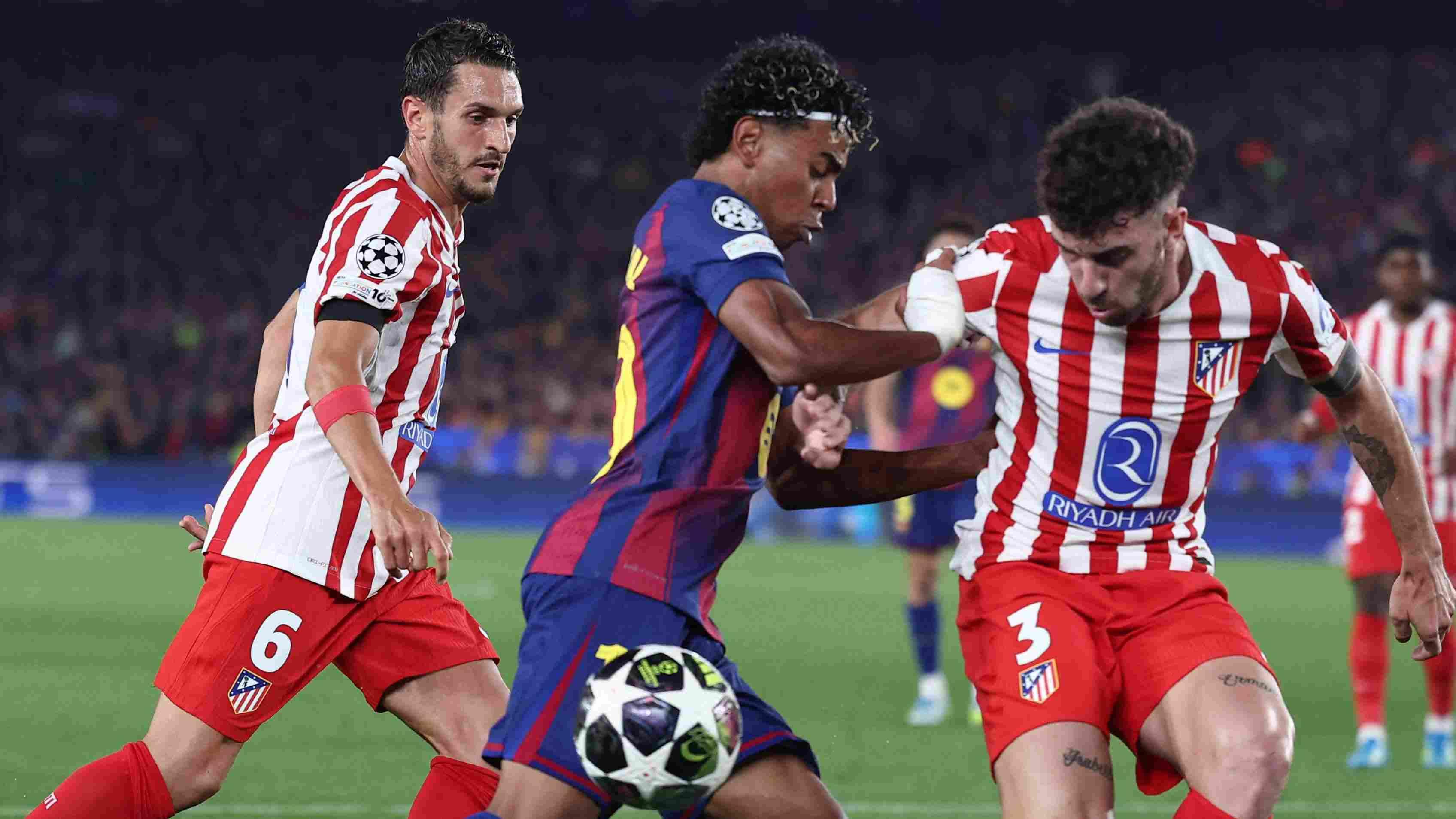
AFP | Muhammad Sharaf Eldeen Apr 09, 2026 06:25 +06:00 | Translated by GOAL
Barcelona and Atlético Madrid served up plenty of rhetoric but precious little substance on the pitch, leaving fans frustrated and the outcome unresolved. The much-hyped showdown fizzled out into a goalless draw, with both defences dominant and the usually incisive attackers largely muffled. In the end, the only thing missing was the proverbial “kill shot” that might have settled the contest.
Supporters on both sides will have to wait just four days for the rematch, when the teams meet again in what is now a genuinely make-or-break encounter. With so much at stake—including a potential Champions League berth—the second leg promises higher stakes and, quite possibly, fewer inhibitions. For now, the talking has stopped; soon, the doing will begin.
#Barcelona #Espanyol #LaLiga #BarcelonaVsAtleticoMadrid #AtleticoMadrid #ChampionsLeague #AtleticoMadridVsBarcelona #HFlick #DSimeone #PCubarsi #MPubill #Spain #Germany #Argentina
Kobarsi’s sudden dismissal has left Barça teetering on the brink of collapse. The board’s decision to sever ties with the experienced coach has sent shockwaves through the dressing room and raised serious questions about the club’s short-term stability. With no obvious successor in place, the leadership vacuum could derail the team’s already fragile season. Supporters, who had grown accustomed to seeing their side challenge for major honours, now fear a prolonged period of uncertainty. The timing could hardly be worse: key fixtures against division rivals loom large, and without a steady hand on the till, Barça risks slipping out of the European places altogether.
On a night that proved the Champions League offers no mercy for individual errors or lacklustre performances, Atlético Madrid managed to emerge victorious (2–0) from Barcelona’s home ground on Wednesday in the first leg of the quarter-finals at the Spotify Camp Nou, for the first time since 2006.
Read also: Atlético Madrid player turns goalkeeper... Did Barcelona deserve a penalty? After a heated row, Arbeloa forces Real Madrid star to apologise to his team-mates.
Meanwhile, in a separate development, U.S. politician Donald Trump has renewed calls to bar transgender athletes from participating in the World Cup. Meanwhile, in World Cup qualifying, Iran has unveiled a contingency plan to secure its place at the tournament, while Egypt’s group remains on high alert.
— AFP
In the fast-paced world of football, certain players possess a “killer card”—a unique, match-winning ability that sets them apart from the rest. This term, borrowed from sports-card culture, describes an athlete whose skills can single-handedly swing the result of a contest. While every team relies on collective effort, the presence of an individual with such a trait often proves decisive when the pressure is highest. Coaches spend seasons searching for players who can step up in the final minutes, and fans celebrate those rare talents capable of producing magic on command. The killer card is not merely physical prowess; it encompasses mental resilience, strategic intelligence, and the courage to take responsibility when it matters most. When a player earns this label, opponents take notice, and defenders prepare for a duel that could define their season. In the following analysis, we examine the characteristics that turn an ordinary performer into a game-breaking phenomenon, and explore why this concept remains central to modern football strategy.
Barça dominated proceedings in the first half, as expected, before the sending-off of their defender Pau Coparce proved to be a decisive turning point in the match. That dismissal mirrored the one handed out to Atlético’s Nico González just four days earlier in La Liga, when the sides had been locked at 1–1. In the second half, Barça exploited their numerical superiority to secure a 2-1 victory through Robert Lewandowski’s clinical finish, edging them closer to the La Liga title.
This time, however, the script was flipped: Kubarsi’s dismissal handed the visitors a dangerous free-kick, which Argentine striker Julián Álvarez dispatched clinically. The resulting free-kick was dispatched into the top corner by Argentine forward Julián Álvarez in first-half stoppage time (45'). With Barça already pushing for a winner, Norwegian striker Alexander Sørloth delivered the coup de grâce, racing onto a through ball and finishing coolly in the 70th minute to secure a 2–1 victory that edges Atlético closer to the title.
In essence, the match swung on two identical moments: a red card and a set-piece strike. First, Barcelona capitalised on numerical superiority to win in La Liga; four days later, Atlético returned the favour. The pattern was the same, yet the outcome was reversed, leaving Camp Nou silenced and the visiting supporters in jubilant celebration.
— AFP
In football, a “controversial touch” is an incident that provokes immediate debate among players, officials and fans. The phrase encapsulates moments when the ball makes contact with a player in circumstances that are far from clear-cut—think of a marginal offside decision, a handball that happens in the blink of an eye, or a goal-line clearance that looks millimetres away from crossing the line. These split-second events often decide matches, and they highlight the razor-thin margin between triumph and heartbreak. Because such incidents cannot be reviewed by video technology, they rely on the instant judgment of on-field referees, further fuelling arguments about human error and fairness. As a result, every controversial touch becomes a flashpoint for discussion long after the final whistle, underlining the sport’s ability to unite and divide in equal measure.
However, the match was not without its share of refereeing controversies. In the 54th minute, Atlético goalkeeper Juan Musso played the ball from a goal kick to his teammate, defender Marc Poblet, who was standing close to him in the six-yard box, before the latter handled the ball and played it again, much to the astonishment of the spectators. The incident provoked immediate protests from several Barcelona players, who argued that Piqué’s handling merited a penalty. However, Romanian referee István Kovács, positioned some 20 yards away, ruled that play should continue. The VAR officials, monitoring the action from their booth at the Camp Nou, did not recommend a review, citing the on-field decision as “clear and obvious”.
In the immediate aftermath, Barcelona coach Xavi Hernández expressed frustration over the “blatant” call, while Atlético captain Koke defended the referee’s judgment, urging reporters to “move on”. Television replays showed that Piqué’s arm was indeed in an unnatural position, yet the lack of a VAR intervention meant the controversy lingered long after the final whistle.
From a rules perspective, Law 12 of the FIFA Laws of the Game states that an indirect free-kick—or a penalty kick inside the box—should be awarded for handling that denies an obvious goal-scoring opportunity. Purists argue that Piqué’s action fell into this category, whereas pragmatists point out that the referee’s primary duty is to maintain flow, especially in tense derbies.
Supporters on social media drew parallels with other high-profile controversies, such as Diego Godín’s similar handball for Uruguay against Portugal at the 2018 World Cup, which went unpunished. Others highlighted the irony that VAR, designed to eliminate such disputes, remained silent on a night when Barcelona’s title hopes hung in the balance. As the debate rages on, one thing is clear: the 2023 Clásico will be remembered not only for the tactics and the goals but also for the moment when technology and human judgment converged—and then receded—in the space of a single touch.
— Getty Images Sport
In football, the phrase “all talk and no action” captures the frustration that fans and coaches feel when a player or team makes grand promises but fails to deliver on the pitch. The Arabic expression “جعجعة بلا طحن” conveys the same nuanced reality: all the pre-match hype, the bold interviews, and the confident predictions mean nothing if the performance does not follow through. This timeless adage reminds everyone in the game—from star strikers to weekend commentators—that ultimate judgment comes not from words but from the cold, hard results on match day.
Barcelona dominated possession (58.3%) and generated 18 shots, with seven hitting the target, while Atlético managed only five efforts, three on frame. The hosts also earned seven corners to their visitors’ single set-piece. Although Barcelona’s expected goals (xG) stood at 1.21 compared to 0.45 for Atlético, according to UEFA and Opta data, the Catalan side still failed to capitalise on their possession and constant pressure, which generated 43 touches inside the opposition’s penalty area compared with just nine for the visitors. In the end, Barça paid a heavy price for their lack of finishing power.
The numbers tell a clear story: despite enjoying 58.3% of the ball and winning 7–1 on corners, the Blaugrana could not translate their dominance into goals. Their 18 shots represented a significant volume, yet only seven were on target, highlighting the defence and goalkeeper’s ability to contain the danger. By contrast, Atlético’s five efforts were more efficient, with three testing the home goalkeeper and underlining the visitors’ counter-attacking threat.
The expected-goals metric (xG) of 1.21 versus 0.45 further illustrates Barça’s control, but it also exposes their inability to break down a disciplined back line. Their 43 touches inside the box should have yielded more than a single effort on target, suggesting a combination of poor decision-making and clinical edge. Atlético, with just nine such touches, were far more direct, though they too struggled to turn chances into goals.
From a tactical perspective, the hosts’ high pressing forced 70% of the game’s duels to be contested in the visitors’ half, and their passing accuracy of 87% in the final third pointed to sharp build-up play. However, the final ball often lacked precision, allowing Atlético’s compact 4–4–2 block to absorb the danger. The away side’s transition speed was evident in their three shots from outside the box, each of which forced saves, underscoring the value of their counter-attacking structure.
In summary, Barça’s statistical superiority did not translate into a winning performance. Their control was comprehensive, but Atlético’s organised resistance and moments of counter-attacking clarity ensured the points were shared. The hosts will review their finishing and defensive solidity, while the visitors will take heart from their defensive resilience and efficiency on the break.
ENJOYED THIS STORY? Add GOAL.com as a preferred source on Google to see more of our reporting
— AFP
In football, the term “decisive moment” encapsulates the instant when a match tilts irrevocably in one team’s favour. It is the culmination of tactics, temperament and a touch of luck. Coaches obsess over creating these moments, while supporters remember them long after the final whistle. For fans of Atlético Madrid, the phrase carries extra resonance, for their side thrives on turning small margins into triumphs. This article examines how the club identifies, engineers and exploits those pivotal seconds that define a season.
Every campaign contains a handful of matches that act as hinges. A single goal, a saving tackle or a goalkeeping miracle can redefine momentum. Atlético’s philosophy is built around patience and discipline; they wait for the opponent to falter, then strike with clinical efficiency. That approach demands mental fortitude, because the decisive moment rarely arrives early. More often than not, it comes when fatigue sets in, when concentration wavers. That is when Atlético pounce.
The club’s history is a catalogue of such moments. From Diego Simeone’s late winner against Liverpool in 2010 to Antoine Griezmann’s double against Bayern Munich in 2016, the pattern is clear: Atlético bide their time, then strike. These incidents are not flukes; they are the result of meticulous planning and an unwavering belief in the collective. The players understand that one burst of intensity, perfectly timed, can neutralise an opponent’s superior possession or shooting statistics.
So how do they create these moments? The first element is defensive solidity. Atlético concede fewer goals than almost any other team in Europe, and that resilience gives them a platform to strike. The second element is tactical flexibility. Simeone is renowned for his ability to adjust formations and strategies during a game, applying pressure exactly when the opposition seems most vulnerable. The third element is psychological conditioning. His players are drilled to believe that fatigue is a choice, that the final 15 minutes belong to those who refuse to accept defeat.
The decisive moment is also a test of character. When the stadium grows silent and the ball lands at a player’s feet, the entire season can hinge on one decision. Atlético’s stars—from Fernando Torres to Jan Oblak—have been trained to thrive under that pressure. They do not shrink; they expand. That mental strength is cultivated through hours of preparation, both on the training ground and in the dressing room, where leaders reinforce the message that champions are made in the most uncomfortable moments.
For supporters, witnessing a decisive moment is a rush unlike any other. The collective gasp, the sudden roar that ripples through the stands, is the sound of 50,000 people realising that the balance has shifted. Atlético fans understand this feeling intimately. They know that their team does not always have the most possession or the most flashy style, but they also know that one swift counter-attack, one well-placed header, can silence critics and secure three points.
In the end, football is a game of margins. The team that can turn a single second into a lasting memory is the team that wins titles. Atlético Madrid has made a habit of doing exactly that. They do not chase beauty; they chase efficiency. And when the decisive moment arrives, they are ready. That readiness, forged through discipline, courage and an unyielding belief in the club’s identity, is what turns potential into reality and supporters into champions.
The numerical disadvantage took its toll on Barça’s physical recovery in the second half, a vulnerability that Atlético coach Diego Simeone exploited to land the decisive blow. With his disciplined defence, razor-sharp transitions and clinical finishing, Simeone’s side punished every opening. Argentine goalkeeper Juan Musso played a pivotal role, producing seven saves to thwart Barça, while his opposite number, Blaugrana shot-stopper Juan García, managed only one.
With his side struggling for cutting edge, Barça coach Hansi Flick tried to shore up midfield and defence through his substitutions, especially after Kubarsi’s red card. He introduced Ferran López for Lewandowski, then Gavi for the injured Pedri. Later he sent on Ferran Torres for Marcus Rashford, Ronald Araújo for Jules Koundé, and finally Alejandro Balde for Cancelo. Despite the late reshuffling, none of Flic’s moves could breach Atlético’s disciplined rearguard, and the hosts held on for a precious win that puts them firmly on course for the semi-finals of Europe’s premier club competition.