GOAL
Tom Hindle
Apr 10, 2026 04:57+06:00
‘Look at all of these stories we can tell’ - How small Danish brand Hummel is reshaping kit culture in America’s lower leagues
Analysis
USL Championship | USL League One | Forward Madison FC | Portland Hearts of Pine | Birmingham Legion FC | Boise
FEATURES
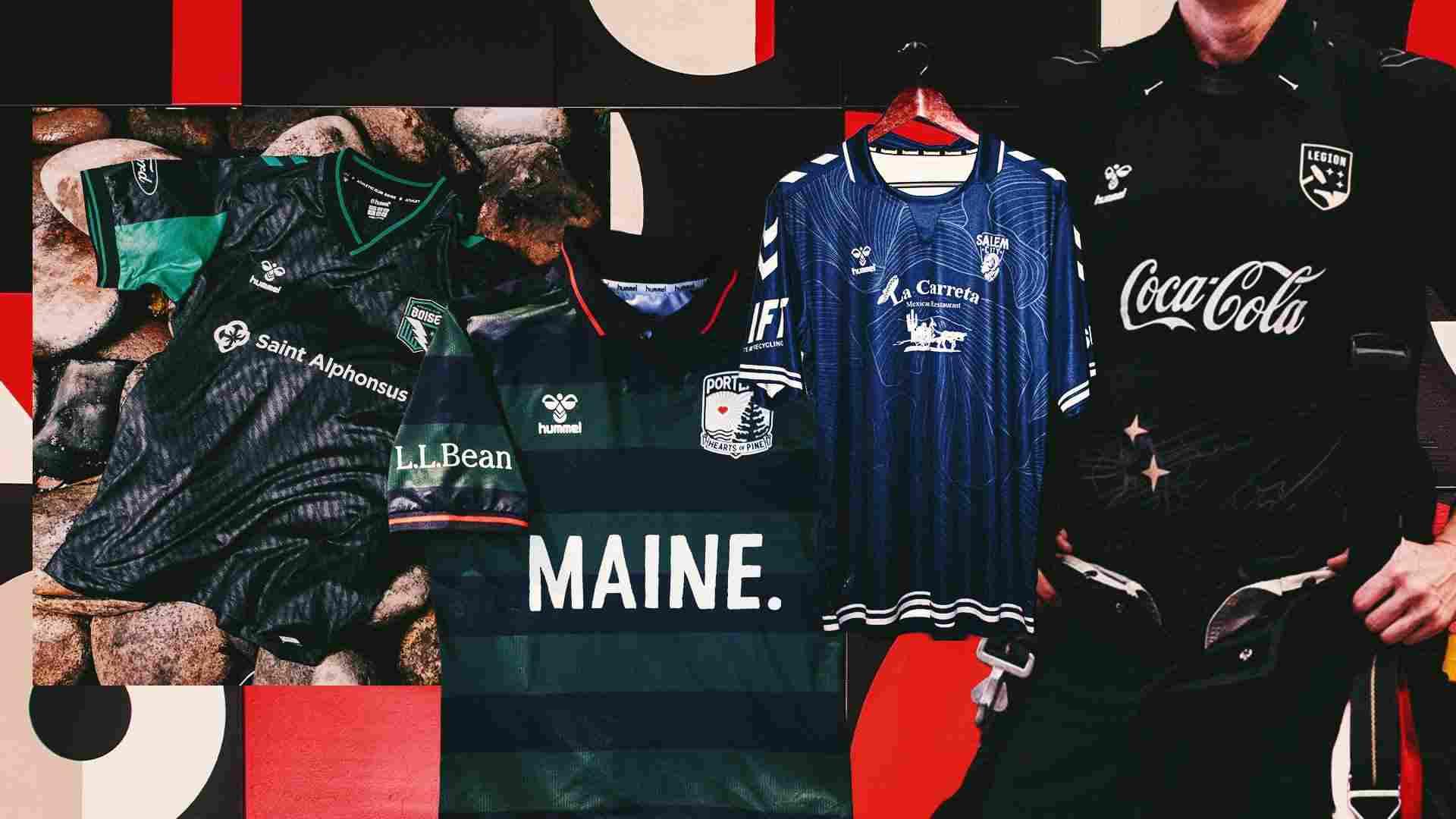
The Danish sportswear company now makes kits for 26 clubs in North America, and has pushed boundaries with innovative designs for USL teams.
There are a dozen donuts on the kit. It was a little bit of fun for Matt Barnhart, head of marketing for USL League Two side Salem City. The away kit, he decided, could be a mad, unpredictable, near-nonsensical canvas. Salem City is hard to pin down, so the away jersey makes no sense. And in its mass of doodles, squiggles, and cartoon figurines, Barnhart hid 12 donuts.
“Krispy Kreme was founded in Winston-Salem. I want people to look at this like those old search and find books you'd have at a dentist's office. And I want them to look at the kit - someone’s sitting at a bar - and you're looking at the back and like, oh, look, there's one donut,” he told GOAL.
Sound absurd? Well, that’s what a lot of USL kits are these days. For all the discourse about the on-pitch product and the future of the league, the design is what tends to captivate a wider audience. And that’s where Hummel comes in.
The Danish brand is a newbie in the American market. Yet its command of the lower league space has allowed smaller clubs to establish themselves in the most modern way possible.
“The next level of cool jersey was that you had to be a professional club. You had to be MLS… And Hummel coming into the market really opened it up,” Barnhart said.
Forward Madison
Relying on speed
The real advantage here is speed. Most companies operate on annual windows - or even two years. Getting a new kit from a larger company, like Adidas or Nike, is a lengthy process - not to mention an expensive one for those purchasing.
Hummel, due to their much smaller size, can operate lighter, speedier, and far more adaptable. They can turn a highly customized, often very nice-looking, jersey around within six weeks. It’s an unusual process.
"The kind of previous pro model for many other suppliers was long lead times, high minimums [for purchasers], and restricted customization,” Conor Caloia, managing partner of Hummel North America and CEO of Forward Madison, told GOAL. “What you're seeing happen with like Portland and Boise and Sacramento and a lot of these great USL partner clubs that we have, they're the ones leading the design, they're the ones telling the community story. They're the ones doing the great kit launch. We're just here to support them."
That has proved to be a sound business model, and a way for a Danish company, with no real presence in the United States, to make an impact.
"I think it's like a great testament to the idea that no creative process or no good idea comes from one person or one team. When we do our best work, it's a collaborative process,” Caloia said.
The process is relatively simple. Hummel works with individual clubs at a comparatively low price point. While most other jersey manufacturers insist on a minimum number of units sold, Hummel’s regulations are either looser or nonexistent. The result is clubs are free to make what they want - and Hummel will more or less make it happen.
Bill Trevaskis
Nudging clubs the right way
Part of the appeal - almost an inadvertent advantage - is that Hummel can’t mass-produce the meticulous knits and elaborate fabrics of their more high-profile competitors. The posh threads of the Brazil away kit at the World Cup aren’t to be found here. That’s not for lack of brainpower as much as a different model.
“We don't have those exact capabilities. We don't have the exact capabilities of, like, creating custom, engineered knit, you know? So, we have to rely heavily on storytelling,” Arsenio Lopez, Art Director for Hummel North America, told GOAL.
Rather than lamenting what they are unable to do, Hummel focused on what is possible. That means focusing on storytelling, and sometimes just creating the absurd.
“We have to rely heavily on storytelling. We have to rely heavily on the customization of graphics. We have to rely heavily on customer service, too - the intimacy of being able to really speak with the club and the people that are making the decisions and getting deep on what it means to them,” Lopez said.
But there can be a little friction there. Some USL clubs have ideas but not much of a vision. Hummel has ambitious designers of its own. And sometimes, they need to nudge clubs the right way.
“It really is very club-dependent. The case of Portland Hearts of Pine, they have an outstanding staff, excellent storytellers, meticulous thinkers, with an amazing eye and visuals,” Lopez said. “They'll come to us with a really clear story.”
Others have a more abstract vision - or no real idea at all.
“There are other clubs where it's like pulling teeth. It's just like, ‘You want to do another map kit?’ Okay, well, how do we put this nicely? These are really played out. How do we, like, talk about something else?” Lopez said.
Getty
How the process works
And in those cases, Hummel gets to have fun. The initial process is highly collaborative. Teams usually come to the manufacturer with a story, an idea, or maybe a few samples. They will identify the number of kits they need and a general direction of colors. Conversations tend to be extensive - but also fast-paced. General ideas are cycled through here and there. Once one hits, a designer will go deeper.
“We come to the club, no designs are created. It’s like ‘This is your narrative for the home kit. Here are three to four sentences that are really inspirational that describe where this idea is coming from,” Lopez said. “We throw a lot of conversation points to be like, ‘hey, look at all of these stories we can tell’.”
And then comes the “mild to wild” scale. Hummel returns with three mockups. One is safe. A second is a little edgy. The third? That’s the bit when they get to go a little bit crazy.
“I try to look for freshness and innovation, or something maybe that club hasn't done before, or something that the club really hasn't celebrated before,” Lopez said.
That requires a bit of back and forth, though. Sometimes, Hummel will come back with something that doesn’t meet the mark. If the understanding is there, though, then everything tends to work out.
“The clubs that really support us as the experts in this field, as the designers and trust us, they're like, ‘You know what? That's super sick. That's basically what I wanted. Let's move on to sampling’ and then, it gets approved and gets created,” Lopez said.
ENJOYED THIS STORY?
Add GOAL.com as a preferred source on Google to see more of our reporting
AC Boise
Deep levels of customization
The club side can get a little more complex. For some, who have a hyperspecific vision, Hummel are an absolute dream. AC Boise have made waves on social media for their kit design. The USL League One club has leaned into the significant Basque population of their city, and reflected as such in their jerseys. That means everything - from colors, crests, and patterns - ties in to their relationship with Basque culture.
Some manufacturers would dismiss their ideas as too nerdy or too specific. Hummel, in effect, honors every request.
"They literally let you customize everything. If you have a little message on the inside of the collar, the cut of the sleeve, the cut of the collar, and It's like, ‘oh my god, everything's a possibility,’,” AC Boise Chief Marketing Officer Jennie Telleria said.
The lack of constraints can lead to some complications, though. Designers need guardrails, Telleria admitted. And sometimes, samples don’t quite align with intent. For example, AC Boise’s kits may be immensely popular, but the first sample didn’t quite hit the mark.
“We completely redesigned the away kit. It went through lots of different iterations before it landed where it's at, and I'm so happy with where it landed,” Telleria said.
Birmingham Legion
Flexibility is an advantage
There are further benefits for the teams themselves. Historically, clubs made one home kit, one away kit, and perhaps a warm-up shirt. Now, further creativity is allowed. There is more detail in goalkeeper kits. Warm-up shirts can be flashier - or made of better material. And with no minimum quantity restrictions, clubs can basically have whatever they want thrown together quickly.
“I can customize a goalkeeper kit and order five of them. I don't have to order 500 of them, which is really, really good for testing stuff,” Steph Wood, Vice President of Marketing & Fan Engagement for Birmingham Legion, said.
That also means that tweaks are easy. When Birmingham asked for cuffs on a kit to tighten the shirts around their players’ arms, Hummel sorted it.
For some clubs, leftover jerseys are an issue. Some kits just won’t sell. That means ordering small quantities - at first, at least - can be helpful to gauge interest.
“For example, 500 shirts doesn't sound a lot, because we get 6,000 every single game. But 6,000 people aren't buying a jersey,” Wood said.
Hummel
Capitalizing off the hype
Hummel now has 26 clubs in North America, as well as a firm foothold in the Canadian Premier League and Northern Super League. They also make the jerseys for Denmark’s National Team.
Hype works for them. Small quantity drops, working with boutique designers, is a strategy ripped out of the streetwear playbook. Caloia thinks lifestyle wear is the next step: hoodies, shirts, crew necks, jackets.
"Our next step is to maybe take that into other apparel pieces beyond the kit, whether it be a match day quarter-zip or jacket or other lifestyle pieces where we think we can get more into that space tied to these great kit designs," Caloia said.
And until then, designers like Barnhart and clubs like Salem City will keep being able to hide donuts in their shirts.
"Look at All the Stories We Can Tell": How Hummel Is Redefining Kit Culture in America's Lower Leagues